

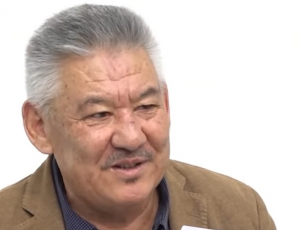
Azimbek Beknazarov
Lawyer, he has worked in the judiciary and the prosecutor’s office and has long-standing experience in both parliament and government. He also served as an ambassador, but his critical stance and active political position significantly affected his diplomatic career.
1. House detention on Kempir Abad case. Currently, the case is under review in the city court (second instance), and a verdict has not yet been delivered. 2. 2024 – Money Laundering Case under a travel ban (no-exit pledge).
Criminal Charges
2002 Case
Beknazarov was prosecuted under the following articles of the Criminal Code:
Art. 177(2) – Abuse of official powers (allegedly exceeding authority in his previous work).
Art. 185(2) – Unlawful detention (accused of detaining a person without legal grounds).
He was arrested in January 2002 and later faced trial.
2022 – “Kempir-Abad” Case
Art. 278 – Organizing mass unrest
Art. 327 – Calls for violent seizure of power
He was detained on October 23, 2022, together with other opposition politicians and activists.
2024 – Money Laundering Case
On September 12, 2024, Beknazarov was charged under Art. 222 – Legalization (laundering) of criminal proceeds in large amounts, allegedly related to funds connected with the April 2010 events.
He was held in the State Committee for National Security’s temporary detention facility but released on November 4, 2024, under a travel ban (no-exit pledge).
1. 2002 Case
In January 2002, opposition politician Azimbek Beknazarov was arrested on charges widely regarded as politically motivated. He was accused under:
Art. 177 (Abuse of official powers)
Art. 185 (Unlawful detention).
His arrest on 5 January 2002 sparked public outrage and international concern about political repression in Kyrgyzstan. The trial began on 12 February, and although he was released from detention on 17 March, the case continued. In May 2002, he was handed a suspended one-year prison sentence.
This prosecution was seen as an attempt to silence opposition, weaken political competition, and suppress dissent. It deepened political tensions in the country and drew strong criticism from international human rights organizations.
2. 2022 – “Kempir-Abad Case”
In October 2022, protests erupted over a border agreement with Uzbekistan involving the Kempir-Abad reservoir. While the government argued the deal was necessary for border demarcation and security, many activists and opposition leaders criticized it as a threat to national sovereignty.
Beknazarov actively opposed the agreement:
He personally visited the disputed areas, documenting conditions and publishing video reports.
He took part in a kurultai (popular assembly), urging society to scrutinize the risks of the deal.
His activism and outspoken criticism became one of the main reasons for his later arrest.
He and other activists were charged under Art. 278 (Organizing mass unrest) and Art. 307 (Attempted violent seizure of power).
Beknazarov was held in SIZO-1 pre-trial detention center for 1 year and 8 months.
On 14 June 2024, the first instance court acquitted Beknazarov and several co-defendants. However, the case is now under appeal at the second instance.
3. 2024 – “Money Laundering Case”
On 12 September 2024, a new case was opened against Beknazarov under Art. 222 (Money laundering of large-scale funds), allegedly linked to funds obtained during the April 2010 revolution.
He was placed in the State Committee for National Security’s temporary detention center.
On 4 November 2024, he was released under a travel ban (no-exit pledge).
Beknazarov and his defense team have called this case politically motivated as well. At present, no clear details are available on the ongoing investigation or trial.
In 2002, Azimbek Beknazarov was detained on politically motivated charges. While in custody, he endured hunger strikes, stress, and ill-treatment. He was held in poor conditions without adequate medical care, which international human rights groups, including OMCT and Amnesty International, condemned as abusive. In 2022, during the “Kempir-Abad case,” Beknazarov spent months in the SCNS pre-trial detention facility under harsh and degrading conditions. Human rights organizations such as Amnesty International, Human Rights Watch, and OMCT reported that detainees, including Beknazarov, were subjected to cruel treatment and psychological pressure. In 2024, he was again briefly detained in the State Committee for National Security (SCNS) facility in connection with the “money laundering case” before being released under a no-exit pledge. Although no severe health problems were officially recorded during this detention, his relatives noted ongoing psychological pressure and high stress.
Beknazarov’s health repeatedly deteriorated while in detention. In 2002, hunger strikes, stress, and inadequate medical care caused serious problems with his cardiovascular and nervous systems, creating a direct risk to his life. In the 2022 case, his condition worsened again, and he required urgent medical care, with both physical and mental health suffering from stress, mistreatment, and lack of treatment. Human rights groups highlighted the risk to his life and demanded his release. In 2024, although no acute health issues were documented, long-term stress and persecution continued to affect his well-being. Across all periods of detention, he required proper monitoring and treatment for cardiovascular and respiratory health, psychological and psychiatric support, and rehabilitation for the effects of torture, stress, and prolonged detention. These medical needs were never fully met.


